Probing the Cosmic Web with Fast Radio Bursts: I. Scattering
Scattering of FRB signals as probes of ionized gas density fluctuations in the cosmic web.
Sharon Lapiner, Nir Mandelker, Paz Beniamini, S. Peng Oh
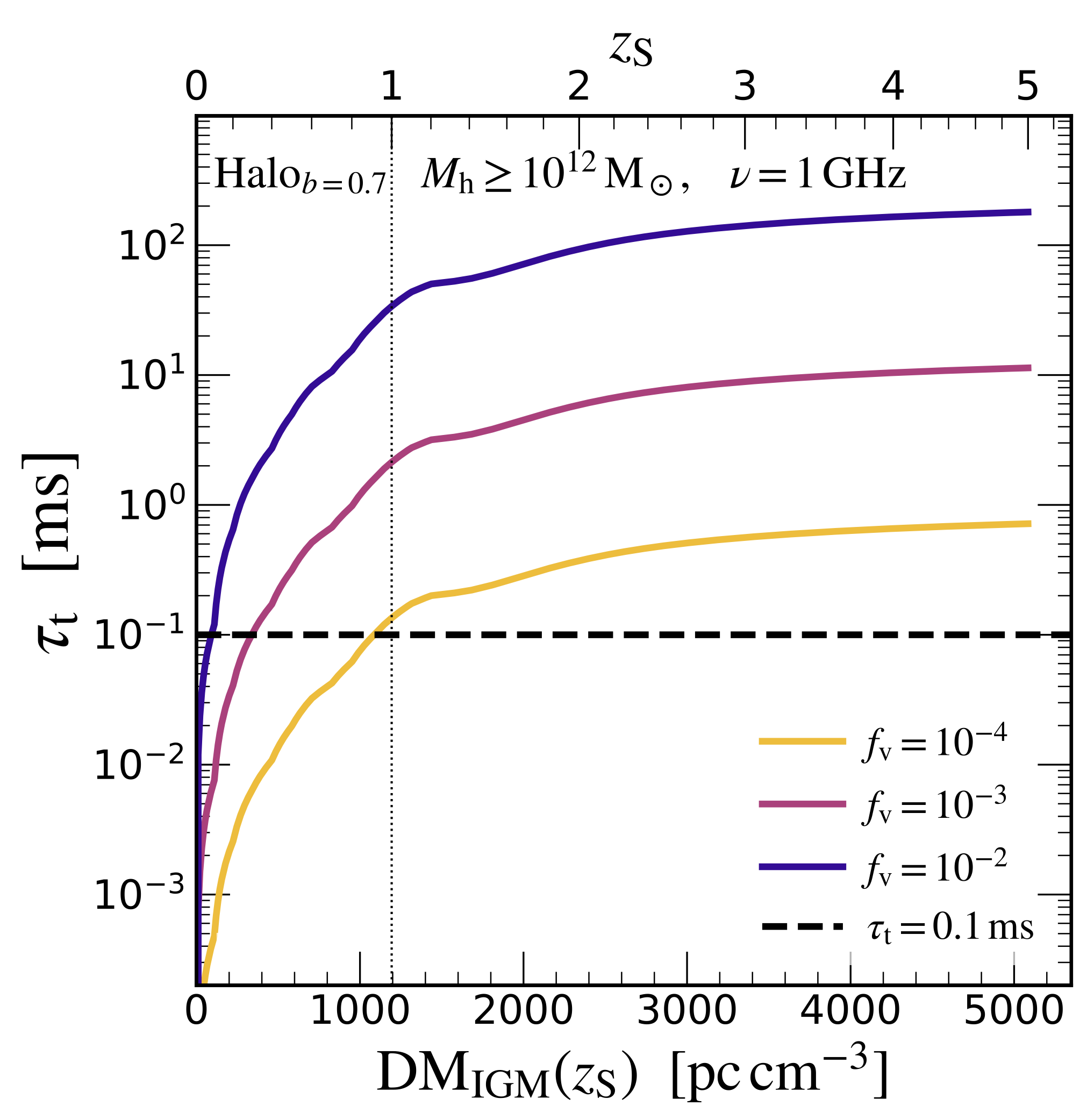
We study the formation of multiphase gas in the post-accretion-shock regions of cosmic sheets, filaments, and the circumgalactic medium (CGM) of haloes, i.e. cosmic web objects (CWOs). Local instabilities in the hot medium result in fragmentation and cooling, eventually forming small-scale overdensities with temperatures of $\sim10^{4}{\,\rm K}$ that are in pressure equilibrium with the hot environment. Such dense, ionised inhomogeneities can affect the propagation of radio waves from fast radio bursts (FRBs), thereby offering us a way to probe their presence and properties in CWOs through scattering signatures in the observed FRB flux.We find that high-$z$ filaments and sheets make a negligible contribution to the total observed scattering. The high rates of FRBs that are expected, even at high redshifts, may still enable their detection from high-temperature filaments along rare sightlines, and we suggest other methods for such systems in a companion paper. Our model further predicts that if turbulent cloudlets exist in the CGM of intervening massive haloes with a volume-filling fraction of $f_{\rm V}\gtrsim10^{-3}$, they are expected to cause considerable cumulative scattering along an average sightline, which would result in a significant correlation between the total scattering time and source redshifts. The lack of such a correlation in current observations may imply that the cool gas in the CGM has substantial non-thermal pressure, which would reduce its density, or significant damping of small-scale density fluctuations. Forthcoming localised FRB samples can map these constraints onto bounds on volume-filling fractions, densities, cloud sizes, and the strength of turbulence.